Why Small and Large Dogs Play Separately
October 16, 2026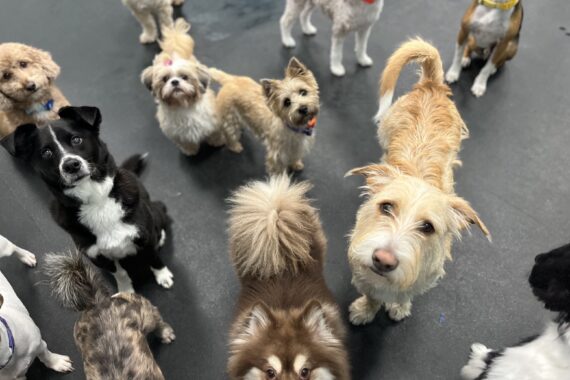
Why Dogtopia of Owings Mills Never Mixes Small and Large Dogs During Group Daycare
Understanding Prey Drive, Size Differences, and Our Extra-Safe Wee Pen
Your tiny Chihuahua might be best friends with a Great Dane at home. Your Golden Retriever might absolutely adore small dogs.
So why doesn’t Dogtopia of Owings Mills allow small and large dogs to play together in the same daycare playroom?
Because even friendly dogs can accidentally injure one another when there’s a significant difference in size, strength, or play style.
At Dogtopia of Owings Mills, we believe that creating a fun, enriching daycare experience begins with thoughtful decisions about how dogs are grouped.
That’s why we maintain separate playrooms for dogs of different sizes and compatible play styles.
And we take our approach one step further with a dedicated Wee Pen for our tiniest furry friends.
Understanding Prey Drive in Dogs
Prey drive is a natural instinct that can cause some dogs to notice, pursue, or chase smaller, fast-moving animals.
The strength and expression of prey drive vary considerably among individual dogs.
A larger dog may become highly interested in a smaller dog that suddenly runs, darts across a playroom, makes an excited squealing sound or whimpers.
In certain circumstances, those movements may trigger predatory behavior rather than ordinary social play.
Veterinary behavior specialists at VCA Animal Hospitals explain that predatory behavior is distinct from other forms of aggression and can involve dogs pursuing other dogs in a non-playful manner.
The American Kennel Club also discusses why it’s important to consider whether a larger dog’s natural tendencies could put a smaller dog at risk.
This doesn’t mean large dogs are inherently aggressive.
It also doesn’t mean that every large dog views smaller dogs as prey.
It means that significant differences in size, movement, and instinctive behavior deserve careful consideration in a group daycare environment.
Size Differences Create Risks Beyond Prey Drive
Prey drive isn’t the only concern.
A large dog can accidentally injure a smaller dog during completely friendly play.
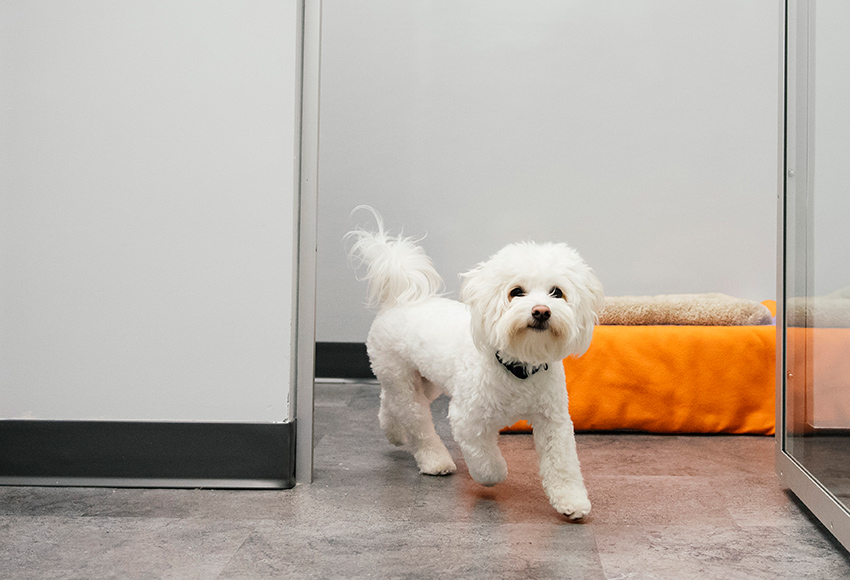
Consider the difference between a 90-pound Labrador Retriever and a 10-pound Maltese.
Both dogs may have wonderful temperaments. Both may genuinely enjoy playing with other dogs.
But their size, strength, and physical resilience are dramatically different.
An enthusiastic collision, an accidental step, or a playful paw movement can have much more serious consequences for the smaller dog.
According to the American Kennel Club’s guidance on small and large dogs playing together, significant size differences increase the risk of accidental injury, even when the dogs get along well.
Potential concerns include:
- Accidental collisions: A larger dog may unintentionally knock over or step on a smaller dog.
- Differences in play strength: Physical play that is appropriate between similarly sized dogs may be too rough for a much smaller dog.
- Chasing behavior: Fast-moving smaller dogs may trigger intense pursuit from certain larger dogs.
- Overstimulation: Excitement can escalate quickly when dogs have very different energy levels and play styles.
- Stress and intimidation: Some smaller dogs may become overwhelmed around larger, more energetic playmates.
Our goal isn’t to suggest that small and large dogs can never safely interact.
Many do so successfully in familiar environments with compatible companions and appropriate supervision.
But a busy daycare playroom presents different circumstances.
Rather than relying on every dog to navigate those differences perfectly, we choose to manage size-related risks proactively.
Why We Separate Dogs by Size and Play Style
At Dogtopia of Owings Mills, dogs are assigned to appropriate play environments based on their size, temperament, and play style.
Our three primary playrooms are:
Toybox: Our Small-Dog Playroom
Our Toybox is designed for smaller dogs to enjoy supervised play with appropriately sized furry friends.
This allows our smaller guests to socialize and move around without the same physical size differences they would encounter in a mixed large-and-small-dog playroom.
Romper: Our Medium-Dog Playroom
Our Romper provides an environment for medium-sized dogs with compatible play styles and energy levels.
Our Canine Coaches supervise interactions and help maintain appropriate group dynamics.
Gym: Our Large-Dog Playroom
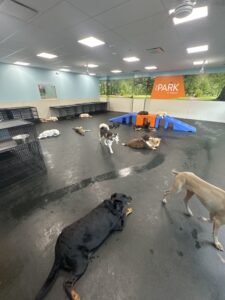
Our Gym is designed for our larger canine guests.
These dogs can enjoy supervised socialization, exercise, and play with appropriately matched companions.
Of course, size is only one consideration.
Our team also evaluates temperament, social comfort, behavior, and compatibility when determining the most appropriate playroom for each dog.
Safe play requires more than simply placing dogs together and hoping everyone gets along.
An Extra Layer of Protection: Our Wee Pen
Here’s something we’re especially proud of at Dogtopia of Owings Mills.
We don’t stop at separating small dogs from large dogs. We also have a dedicated Wee Pen that allows us to provide additional separation for our tiniest furry friends.
Why does this matter?
Because even among dogs considered small, physical differences can be significant.
Think about a tiny Chihuahua or delicate toy-breed dog playing alongside an energetic 25- or 30-pound dog.
Both may fall within a broad small-dog category, but their body size, strength, and preferred play styles can be very different.
Our Wee Pen gives our team another option for creating an appropriately sized, comfortable play environment for our smallest guests.
This additional separation helps us:
- Reduce the risk of accidental collisions with larger small dogs.
- Better manage differences in strength and play intensity.
- Provide a potentially less overwhelming environment for very small dogs.
- Match dogs with compatible playmates.
- Add another layer of thoughtful management beyond our standard size-separated playrooms.
The American Kennel Club’s training guidance for small dogs recommends considering similarly sized playmates to help reduce accidental injury risks.
Our Wee Pen reflects that same principle.
Because even our tiniest dogs deserve big safety standards.
But My Small Dog Plays With Large Dogs at Home!
We hear this from pet parents, and we completely understand.
Many small dogs live happily with large dogs. They may sleep together, play together, and have wonderful relationships.
That’s fantastic!
But there’s an important difference between dogs who live together and dogs interacting in a group daycare environment.
Dogs who share a home generally have established relationships, familiar routines, and experience communicating with one another.
In daycare, dogs may encounter unfamiliar playmates, new social dynamics, and higher levels of excitement.
The American Kennel Club notes that compatibility, environment, familiarity, and close supervision all influence whether small and large dogs can play safely together.
At Dogtopia of Owings Mills, we choose to minimize significant size differences in our group playrooms.
It’s a proactive safety policy, not a judgment about whether an individual large dog is friendly.
Why Supervision Alone Isn’t Our Only Safety Measure
Having highly trained Canine Coaches is essential.
But we believe a thoughtfully managed daycare environment involves more than simply watching dogs play.
It starts with the decisions made before dogs enter a playroom.
Our approach includes:
- Separate playrooms for small, medium, and large dogs.
- An additional Wee Pen for our tiniest guests.
- Grouping dogs by compatible temperament and play style.
- Highly trained Canine Coaches.
- Supervised, structured group play.
- Careful observation of canine body language.
- Appropriate breaks and rest periods.
- Thoughtful policies designed to reduce avoidable risks.
We also limit traditional dog toys during regular group daycare play to reduce potential competition and resource guarding.
Read More: Why We Limit Toys During Regular Group Play
Questions to Ask When Choosing a Dog Daycare
If you’re researching dog daycare in Owings Mills, Reisterstown, Pikesville, or surrounding Baltimore County communities, we encourage you to ask prospective facilities:
- Are small and large dogs separated during group play?
- How are dogs evaluated before joining a playroom?
- Are dogs grouped by both size and play style?
- Is there a separate option for very small or delicate dogs?
- How are chasing and overstimulation managed?
- What training do the staff members supervising play receive?
- What happens when a dog becomes uncomfortable or needs a break?
A facility should be able to explain its safety policies clearly and confidently.
We believe pet parents deserve to understand the reasoning behind the environment where their dogs spend their days.
Small Dogs Deserve Big Safety Standards
At Dogtopia of Owings Mills, we believe every dog deserves a fun, enriching daycare experience that respects their individual needs.
Whether your pup is tiny, small, medium, or large, our goal is to provide an environment where they can socialize, exercise, and enjoy their day with compatible furry friends.
Our size-separated playrooms help us manage the physical differences between dogs.
Our highly trained Canine Coaches provide attentive supervision.
And for our tiniest pups, our Wee Pen adds another layer of thoughtful care.
Because your dog’s safety isn’t an afterthought. It’s part of how we design their entire daycare experience.
Experience the Dogtopia Difference
Looking for dog daycare in Owings Mills, Reisterstown, Pikesville, Garrison, Stevenson, or surrounding Baltimore County?
We’d love to introduce you to our playrooms, our highly trained team, and our approach to supervised group play.
Schedule your dog’s Meet & Greet at Dogtopia of Owings Mills today!